Headline News Archive
 In 2009, the National Oceanic and Atmospheric Administration’s Gulf of Mexico Regional Collaboration Team and the four Gulf of Mexico Sea Grant Programs began working together to form the Climate Community of Practice. The Climate Community of Practice is setup to allow local decision-makers and extension, outreach and educators to work together to incorporate all types of coastal hazards into Gulf Coast communities comprehensive plans.
The Climate Community of Practice hosts a series of virtual sessions on various climate- and resilience-related topics, including the upcoming Neighborhood Resilience session taking place on October 14, 2020. The October session will take place from 1:00 pm to 2:30 pm CST and will feature three experts undertaking neighborhood resilience from multiple perspectives.
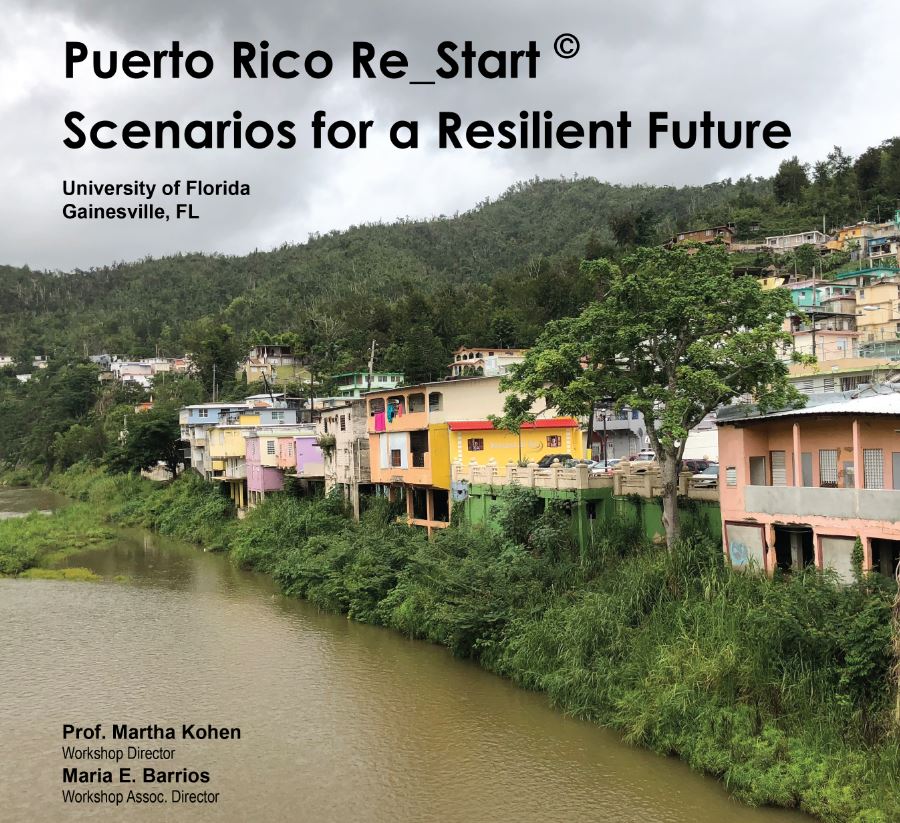 The University of Florida’s Center for Hydro-generated Urbanism (CHU) and the Polytechnic University of Puerto Rico, with sponsorship from the UNESCO Chair on Sustainable Urban Quality and Culture, released a new report titled “Puerto Rico Re_Start: Scenarios for a Resilient Future.” The report showcases the work resulting from the collaboration between CHU with Puerto Rico around multiple climate-related issues, in particular recent devastating hurricanes, sea level rise and flooding resilience, as well as infrastructure hardening. Inclusive, participatory workshops have involved scholars and students, professionals and administrators, NGOs and international partners. Save the date for the next workshop, “Puerto Rico Re-Start 4,” that is set for March 21 – 27, 2021. More info can be found HERE.”
The UF Department of Soil and Water Sciences and UF/IFAS Extension Service recently released a new report about climate change in Florida in a reader-friendly, science-based Q&A format.
Some of the questions addressed in the publication include:
- How do we know the climate is changing?
- What are greenhouse gasses and where do they come from?
- Is climate changing in Florida, and what are the long-term projections?
- Why are sea levels rising?
The document stemmed from a project the team worked on last year with Thriving Earth Exchange. Residents and employees of the city of Hallandale Beach attended a forum with the aim to increase climate literacy for the city staff. At the forum, staff members had the opportunity to ask questions about climate change directly to scientists.
The announcement of the publication and the full pdf are both available online.
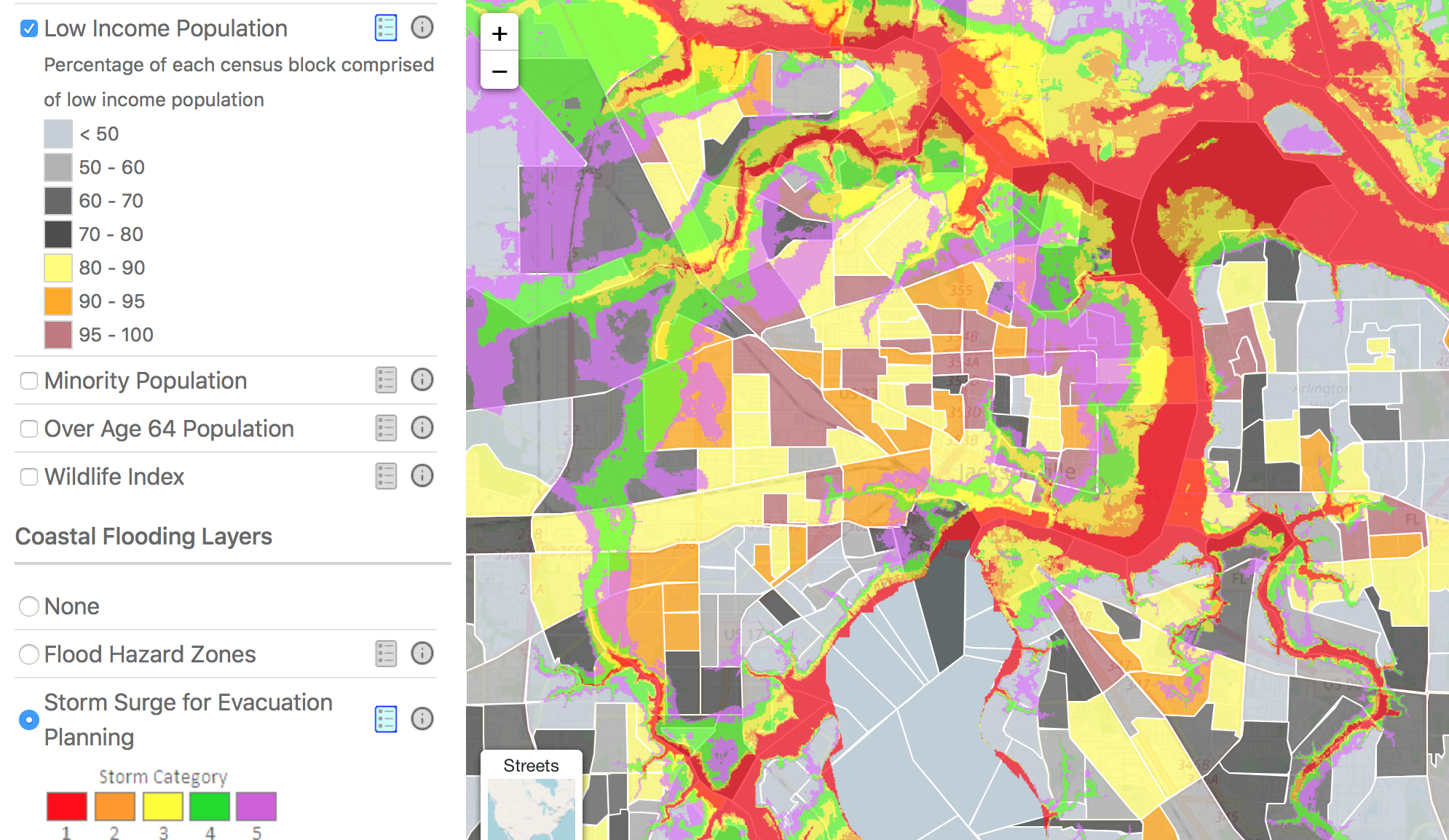 In Northeast Florida, a new resource is educating local stakeholders about coastal hazards and vulnerabilities. The "Regional Resilience Exposure Tool," licensed by the Northeast Florida Regional Council (NEFRC) and developed by Taylor Engineering, allows local residents, business owners, and government actors to determine if resources are exposed to specific coastal hazards. In addition to coastal flood layers, the tool features other data layers relating to demographic and social measures that can be visualized in a variety of ways.
The Regional Resilience Exposure Tool (R2ET) is intended to function as a base-line resource for citizens, businesses, and governmental actors to kickstart conversations about sea level rise and emergency preparedness. Utilizing this tool, as well as other community engagement resources offered by the Northeast Florida Regional Council, local communities can have better-informed conversations about building a resilient future. The tool has been utilized to support data and analysis sections of local government comprehensive plans, and is currently being used to better inform the work of the Jacksonville City Council, Special Committee on Resiliency.
To check the exposure of a local community asset in Northeast Florida, visit the official webpage for the Regional Resilience Exposure Tool.
Seminole State College of Florida now offers a fully online post-baccalaureate certificate in Sustainability Management. The certificate is open to anyone with a bachelor's degree from a regionally accredited institution. Sustainability has moved beyond a mere buzzword to become a growing industry with loads of career potential as more organizations are implementing sustainability programs as part of their business model. Through the Sustainability Management Certificate of Professional Preparation, bachelor's degree holders can enhance or build their skills with training that will allow them to help companies incorporate sustainability efforts into their business goals to benefit their bottom line, and the planet. Contact Dr. Chris Boehner at
 By invitation of the Risk Management and Decision Processes Center at the University of Pennsylvania's Wharton School, Thomas Ruppert, with Florida Sea Grant, contributed to the fifth Digital Dialogue on "Scaling up Coastal Ecosystem Protection." He joins thirteen other experts to discuss financial measures and policies that are most successful for scaling up coastal ecosystem protection. His segment is a drastically shortened version of the book chapter "Take Out the Trash When You Leave: Cleaning Up Properties Abandoned to Rising Seas," which will appear in the forthcoming book "A Blueprint for Coastal Adaptation" by Island Press. Digital Dialogues, hosted by the Risk Management and Decision Processes Center at the University of Pennsylvania's Wharton School, are short and concise summaries of policy innovations addressing large, critical problems facing society.
- PBS Digital Series "Global Weirding", with Dr. Katharine Hayhoe of Texas Tech University. The series includes over 30 short videos on a range of climate science topics, including a video on climate impacts in the Southeast U.S.
- YouTube channel that includes over 200 lectures, talks, and interviews given by Dr. Katharine Hayhoe.
- Denial 101x, which features conversations with dozens of top climate scientists from around the world who dive deeper into specific scientific topics.
- The Thinking Person's Guide to Climate Change, by Bob Henson, a climate blogger at Weather Underground and a former science writer at the National Center for Atmospheric Research.
- Fourth National Climate Assessment Volume I and Volume II, by the U.S. Global Change Research Program.
- Amazon reading list assembled by Dr. Katharine Hayhoe of Texas Tech University.
The article "Roads to Nowhere in Four States: State and Local Governments in the Atlantic Southeast Facing Sea-Level Rise", an assessment of coastal communities facing sea level rise and flooding co-authored by FCI affiliate Thomas Ruppert with Florida Sea Grant, has received further recognition. In addition to being selected as one of the top 4 environmental law articles by Vanderbilt Law and the Environmental Law and Policy Annual Review (ELPAR), the article was recognized as one of the top 15 environmental law articles of the year by the Thomson Reuters/West Publishing 2020 Land Use & Environment Law Review. "Roads to Nowhere in Four States" is the only article appearing in both the top 7 finishers in the Vanderbilt Law and ELPAR award and the top 20 in the Thomson Reuters/West Publishing 2020 Land Use & Environment Law Review.
In addition, the "Coastal Conundrum" podcast, part of the American Shoreline Podcast Network, released the "Road to Nowhere-The Legal Issues Behind Climate Adaptation" podcast on August 12. The podcast features lead author Shana Jones, of Georgia Sea Grant & Vinson Institute for Government, and Thomas Ruppert discussing the legal issues addressed in the article. Listen to this insightful podcast as well as other podcasts on the American Shoreline Podcast Network.
The Federal Emergency Management Agency (FEMA) has announced the Notice of Funding Opportunities (NOFOs) for the Fiscal Year 2020 Flood Mitigation Assistance (FMA) grant program and the new Building Resilient Infrastructure and Communities (BRIC) pre-disaster mitigation grant program. The BRIC Program will support states, local communities, tribes and territories as they undertake hazard mitigation projects, reducing the risks they face from disasters and natural hazards. BRIC is a new FEMA pre-disaster hazard mitigation program that replaces the existing Pre-Disaster Mitigation (PDM) program.
This year there is $660 million available for the FMA and BRIC programs combined. There is $160 million available in funding for FMA and $500 million for BRIC. The application period opens on September 30, 2020.
 The CDC has published a new document Preparing for the Regional Health Impacts of Climate Change in the United States. The publication describes the various health impacts climate change will have on different regions of the United States, actions taken by the CDC Climate and Health Program's health department partners to prepare for and respond to climate change in their communities, and relevant tools and resources.
 The Federal Emergency Management Agency (FEMA) has released the publication, Building Community Resilience with Nature-Based Solutions. The key goal of this guide is to help communities identify and engage the staff and resources that can play a role in building resilience with nature-based solutions. This guide defines nature-based solutions as sustainable planning, design, environmental management, and engineering practices that weave natural features or processes into the built environment to build more resilient communities. While this guide uses the term nature-based solutions, other organizations use related terms, such as green infrastructure, natural infrastructure, or Engineering with Nature®, a program of the U.S. Army Corps of Engineers. The focus of this guide is local communities, but many of the ideas and advice may also apply to state, territorial, and tribal governments.
 Students in the University of Florida's environmental journalism class spent their spring semester on an in-depth report on climate change and public health in Florida -- The Human Hazard -- now published in full on WUFT.ORG, the UF College of Journalism and Communications' public media platform. The four-part series, which included stories on the expansion of vector-carrying mosquitoes, rising heat-related hospitalizations, and other public-health trends, found that vulnerable populations are particularly susceptible to these risks, now amplified by coronavirus as basic programs have been suspended to contend with the emergency. FCI affiliate faculty member Cynthia Barnett taught the class, beginning the semester with lectures and database workshops by Florida Climatologist David Zierden and other experts. The College of Journalism is also a member of the Florida Climate Reporting Consortium, which picked up some of the stories in major media outlets in Tampa and Miami.
Florida's Executive Office of the Governor has released the Chief Resilience Officer (CRO) 2019 Annual Report prepared by Julia Nesheiwat, the state's former CRO. The 36-page report discusses the Officer's goals and proposes "what can be done to start effective resilience planning and action." Download a copy of the report here.
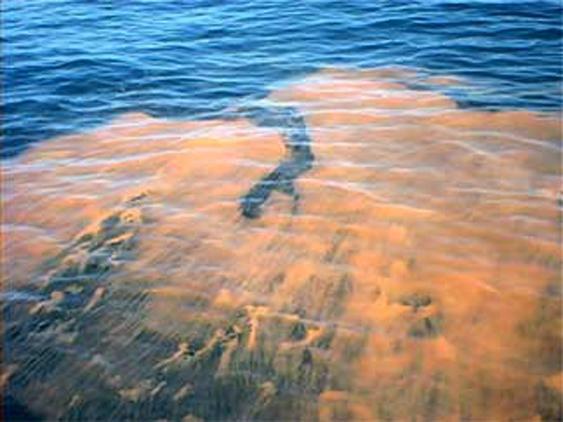 The Gulf of Mexico Coastal Ocean Observing System (GCOOS) and NOAA's National Centers for Coastal Ocean Science (NCCOS) are funding two new studies designed to uncover the full costs of harmful algal blooms (HABs) across numerous sectors - from tourism and seafood to industries where impacts are less visible, such as healthcare and construction. As a state that relies heavily on these sectors, Florida is especially vulnerable to the socioeconomic damages of toxic blooms. This was apparent during the prolonged red tide that began in 2017 and lasted through early 2019, causing the state's governor to declare a state of emergency.
The funded studies will evaluate the sociological and economic impacts of Florida's 2017-2019 red tide event and develop a framework to inform future assessments of other HAB events with the goal of mitigating economic impacts on communities.
"From Bloom to Bust: Estimating Economic Losses and Impacts of Florida Red Tide (Karenia brevis)" will be conducted by Drs. Sergio Alvarez from the University of Central Florida and Dr. Heather O'Leary from the University of South Florida. This two-year project will examine the economic impacts of K. brevis events across 80 different sectors, based on varied bloom occurrence and intensity. Understanding the true costs of HABs is key to developing effective response and adaptation strategies that meet the needs of impacted communities in Florida and around the country.
"Assessment of the short- and long-term socioeconomic impacts of Florida's 2017-2019 Red Tide event" will be conducted by Drs. Christa Court, Xiang Bi, Jin Won Kim, Angie Lindsey, Stephen Morgan, Andrew Ropicki and Ricky Telg from the University of Florida and David Yoskowitz from the Harte Research Institute, Texas A&M University Corpus Christi. This two-year project will comprehensively quantify and qualify the short- and long-term socioeconomic impacts of the 2017-2019 Karenia brevis event in Florida and develop a transferable framework to help inform national-scale efforts focused on quantifying as well as measuring community vulnerability and resiliency.
 The Southeast Florida Regional Climate Change Compact has published a guidance report to accompany the third update of the Regionally Unified Sea Level Rise Projection for Southeast Florida. The projection was released in December 2019 at the Compact's 11th Annual Climate Leadership Summit. The updated projection and accompanying guidance report are currently in the process of final review and acceptance by all four of the Compact counties.
Regionally Unified Sea Level Rise Projection and this guidance document were developed by an ad hoc Sea Level Rise Work Group of experts from academia and federal agencies, and supported by individuals from local government and Compact staff. The guidance report is intended to assist decision-makers at both the local and regional levels in Southeast Florida to plan for and make decisions about sea level rise and associated vulnerabilities based on best-available science.
 Each year, local health departments spend considerable time and expense preparing for and responding to extreme weather events, which are growing more severe due to climate change. However, only 11% of local health departments report conducting activities related to climate change preparedness. The National Association of County and City Health Officials (NACCHO) has published a new information sheet - How to Frame the Health Impacts of Climate Change - to help health departments frame their work around climate change when communicating with the public.
Floridians believe climate change is real and are concerned about its impact on future generations in the state, according to the second Florida Climate Resilience Survey, conducted by the Florida Atlantic University Center for Environmental Studies (CES) in FAU's Charles E. Schmidt College of Science, and the Business and Economics Polling Initiative (BEPI) in FAU's College of Business. This quarterly statewide survey shows that 86 percent of Floridians believe climate change is happening, including 81 percent of Republicans, 91 percent of Democrats and 87 percent of Independents.
 (Source Climate Outreach) Having conversations about climate change in our daily lives plays a huge role in creating social change. People take cues about what's important from what family, friends, colleagues and neighbors are talking about. That's why Climate Outreach has produced an evidence-based, practical guide to help make those conversations easier and more meaningful - and to come out of them feeling inspired and connected. Talking Climate Handbook is the result of a collaboration with Climate-KIC. It is based in part on a citizen science project with over 550 individuals from over 50 countries that took place last summer. Download the handbook here.
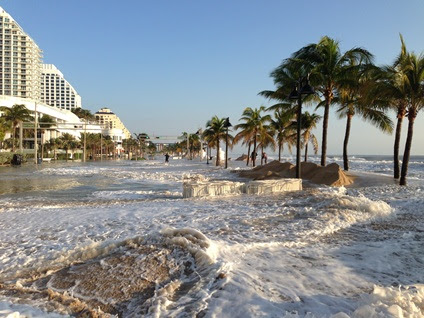 (Source: Science World) Half of the world's beaches could disappear by the end of the century due to coastal erosion, according to a new study led by the European Commission Joint Research Centre (JRC). Erosion is a major problem facing sandy beaches that will worsen with the rising sea levels brought about by climate change. According to the study, published today in Nature Climate Change, effective climate action could prevent 40% of that erosion. Sandy beaches cover more than 30% of the world's coastlines. They are popular recreational spots for people and they provide important habitats for wildlife. They also serve as natural buffer zones that protect the coastline and backshore coastal ecosystems from waves, surges and marine flooding. Their role as shock absorbers will become more important with the rising sea levels and more intense storms expected with climate change. Read article here.
- Florida Public Service Commission Unanimously Approves Largest Community Solar Program in the Country
- Videos from 5th Annual Climate Communication Summit Now Available
- Proposed Florida Climate Assessment
- Check out the Coastal Planning and Sea Level Rise Newsletter from Thomas Ruppert of Florida Sea Grant


The Florida Climate Institute (FCI) is a multi-disciplinary network of national and international research and public organizations, scientists, and individuals concerned with achieving a better understanding of climate variability and change.